


 Posts
Posts


Master Qu Hai is a native of Yantai, birthplace of Praying Mantis kung fu. He is a 9th generation master of Taiji-Meihua Mantis, and a disciple of Li Kun Shan’s grandson, Zhang Bing Dou. He has practiced mantis since his early teens and is also a qualified Tui Na massage therapist and acupuncturist.
Shifu, could you please talk about your experience learning kung fu:
Well, when I was young, I was always interested in kung fu, and Shandong being the home of mantis, it was only natural that I chose it. I began training in basics and forms with a local master, but he was very busy and so recommended I follow a master in Qingdao, Zhang Bing Dou.
We would train in the evenings in Masters house, training was very slow and repetitive, we would get one move and just work that until Master was happy, then he would give us another one. Sometimes he would just send us home to work on one move and tell us to come back next month, then he would look at it and say its not good enough, go back and practice! Also, my master wanted to test you, to see what kind of person you are. You have to have a good character, and strong resolve. He won’ tell you anything for a long time, just make you repeat. Maybe after a period of time he will tell you what you’re doing wrong. You see, in kung fu, you must think for yourself, its not just about asking your master all the time.
For the first year, I just worked on basics, then forms. Later, I learnt paired practice, weapons and qigong. Forms are very important; they must be done with intent. It’s this intent that separates kung fu from mere wu shu. We would take single moves from forms and repeat them over and over again. If we didn’t understand an application, Master would make us spar, just using this one move. We never had mats on the ground or gloves like you guys. You can’t be afraid of being hit. Forms and sparring are interconnected, there is a saying: “spar like you’re doing a form, do a form like you’re sparring.” This is very important.
Shifu, how did you come to learn Ba Gua?
After studying mantis for a long time and having a high level, I felt like I wanted to broaden my horizons. I began to meet with people from other styles to exchange ideas with them. I took an interest in Wuxing Tongbei and Da Cheng Quan (Yi Quan). Later, I began to read about Ba Gua Zhang. After contacting a master named Wang Shang Zhi on the internet, I travelled to Beijing to meet him. We met in a park and discussed kung fu. I felt that he had a very high level and deep understanding, and I really liked his kung fu. So I spent three years living in his home studying Yin style Ba Gua. Master Wang made and sold redwood furniture, sometimes I would help him with his work. When we trained, I was often paired up with a huge guy, who was very strong. I had to use my brain to be clever. I couldn’t defeat him with brute force. Our master focused a lot on paried practice, and feeling the opponent. We learnt through doing and feeling, rather than explanations. The point was that if you got hit, you learnt something. Maybe your guard was down, maybe you left yourself open. So you wouldn’t do that again. Slowly you would learn and improve.
There is much talk about the differences between internal and external kung fu, what are your thoughts?
Actually there is no difference really. The names “internal” and “external” came about after the twentieth century. You must have internal and external together, internal power comes from correct body mechanics, and from intent. When you practice forms, you must have the intent of fighting. Don’t just do the movements, imagine there is an opponent, make your movements fast and flow together. In a fight you don’t stop after each punch, the same in forms. You can do three or four movements within one body movement. This is real kung fu, its not step 1, step 2, step 3 like you see in a magazine. That is just a beginner’s level. Also, you must use muscular power together with intent; you need to train power. Take Taiji for instance, most people think its all soft and powerless, in fact real Taiji training is tough and has high demands for power training. All kung fu is the same, you need a strong body to generate power, and you need intent to use your power.
Shifu, I find it difficult to explain mantis to people, it’s quite an eclectic style:
Well, basically, mantis takes the principles of how a praying mantis will catch it’s pray as a foundation. As mantis was created quite late, it was able to further absorb the strong points of other styles to add to this foundation. It is heavily influenced by Chang Quan, Tongbei Quan, Taiji Quan as well as others. The body must move as a whole unit, using circular movements, half circles and spirals, as well as the unity of opposites, such as forward and backwards, opening and closing etc.
And what about the differences between the different branches:
In fact, in the beginning, there was no separation of different branches. Liu He (6 harmonies) mantis was created fairly early, it has a different syllabus and principles to the other branches. Qi Xing (7 stars) and Taiji separated much later, and in fact the similarities are greater than the differences. Taiji and Meihua is pretty much the same thing, its only personal preferences as to the name used. Qi Xing uses the principle of body parts relating the 7 stars (the big dipper), and that these 7 parts should move in union. Taiji uses the principles of Yin and Yang, or opposites, like left and right, forward and backward, so that the body moves harmoniously and generates the most power. Meihua refers the footwork and hand methods; that they move in a plum blossom shape, attacking the opponent from different sides. All the styles have long and short, hard and soft, the principles are the same. It’s just like if I teach 5 of you, you will have Will mantis, Eric mantis, etc, you all have your own characteristics.
Shifu, how did you come to learn Chinese medicine?
In fact, my first master suffered from a bad lower back, so I wanted to learn massage to help him. Later, my interest grew and I saw how deep it is. I went to Jinan and later to Beijing, to gain my qualifications in Chinese medicine.
Finally, Shifu, can you tell me what you think the benefits of Mantis are:
Well, it can harmonise your body, kung fu exercises your body as a whole. Not only that but it is good for self defence, health preservation and making yourself stronger in body and mind. It can help you to become a better person, improve your heart and mind. You will be able to face whatever challenges life throws at you with a very peaceful and calm mind. You won’t be so stressed and worried, and will have more confidence in yourself.
Shifu, thank you for your time and sharing your knowledge with us!
For more interviews like this, visit http://monkeystealspeach.co.uk
Tuesday, 26 April 2011

Saturday, 29 May 2010
Jin Gang Li Gong, Iron Strength Qigong
The style of Qigong I practice is called Jin Gang Li. It is a martial art Qigong, which means there is a large focus on building up and developing internal power.
 The main method of practice is standing posture, where you hold your hands in front of your chest as if holding a ball and a bent knee stance with the toes turned in slightly. This strengthens the leg muscles and after years of practice condenses the bones. While standing, we focus on building and strengthening the Dan Tian, which is the area of the lower belly, beneath the navel. There are actually three Dan Tians, but the lower one is the foundation, the part of your body where Qi is stored. The lower Dan Tian is strengthened through concentration on that area and deep breathing. You must breathe all the way down into your lower belly, expanding it. After a while of dedicated practice, you will begin to feel warm, numb or inflated feelings in your lower belly. This means Qi is beginning to accumulate here. It is recommended you stand for a bare minimum of 30 minutes, but 1-2 hours will give you greater benefits. It also requires long term persistence, you wont get any benefit just doing it on and off, it must be done daily.
 Another important part of Jin Gang Li is Iron Shirt training, which is conditioning the body to withstand blows. Any part of the body can be conditioned, such as the back, ribs, stomach, arms, palm, fingers, even the head. Advanced practitioners can take full power kicks to the stomach or ribs, have sticks broken over their back, break metal bars over their heads and more.
Jin Gang Li is an art which is being practiced less and less. Master Guo told me that nowadays, young martial artists want to do acrobatics and kickboxing, nobody wants to stand on one spot for long periods of time, so the art is not spreading. There are many westerners who come to our academy and they learn Qigong from Master Guo, but few will be around long enough to get a high level in the system. In 8 months I have got to focussing on the middle Dan Tian and the Moon form, but with my main focus being Mantis Kung Fu, I dont have the time to really focus on Qigong. Perhaps in the future, when my Kung Fu is much better, I can spend some time to focus more on this interesting art.
 The main method of practice is standing posture, where you hold your hands in front of your chest as if holding a ball and a bent knee stance with the toes turned in slightly. This strengthens the leg muscles and after years of practice condenses the bones. While standing, we focus on building and strengthening the Dan Tian, which is the area of the lower belly, beneath the navel. There are actually three Dan Tians, but the lower one is the foundation, the part of your body where Qi is stored. The lower Dan Tian is strengthened through concentration on that area and deep breathing. You must breathe all the way down into your lower belly, expanding it. After a while of dedicated practice, you will begin to feel warm, numb or inflated feelings in your lower belly. This means Qi is beginning to accumulate here. It is recommended you stand for a bare minimum of 30 minutes, but 1-2 hours will give you greater benefits. It also requires long term persistence, you wont get any benefit just doing it on and off, it must be done daily.
 There are also supplementary moving forms and sitting meditation. The sitting meditation focuses on using the mind to guide the Qi through different channels in the body. The moving forms help to strengthen the body, open meridians and release power. The first moving form is a collection of six basic movements which do all of the above. Then, there is the Sun form, which opens the meridians between the hands and the lower Dan Tian and increases the Qi flow there. The next form is the Moon form, which is taught once the middle Dan Tian, located at the solar plexus is opened. The middle Dan Tian acts as a kind of pump, it helps send your Qi from your lower Dan Tian to different arts of your body. The Moon form helps to open and strengthen the middle Dan Tian and the chest. The next step is the Heaven form, which focusses on releasing power. A a higher level, once your lower and middle Dan Tians are both full, you can work on the upper Dan Tian, orthird eye. This is located between the eyes, and is said to be the gateway into developing more esoteric powers, such as being able to send you Qi out of your body and other skills. I have been fortunate enough to feel this, when I had lower back trouble, while standing in Qigong, Master Guo would come over and press his thumbs into my back every day for a week. I got a feeling of intense heat coming from his thumbs into my back and my whole got a hot flush and I started sweating intensely.

Jin Gang Li is an art which is being practiced less and less. Master Guo told me that nowadays, young martial artists want to do acrobatics and kickboxing, nobody wants to stand on one spot for long periods of time, so the art is not spreading. There are many westerners who come to our academy and they learn Qigong from Master Guo, but few will be around long enough to get a high level in the system. In 8 months I have got to focussing on the middle Dan Tian and the Moon form, but with my main focus being Mantis Kung Fu, I dont have the time to really focus on Qigong. Perhaps in the future, when my Kung Fu is much better, I can spend some time to focus more on this interesting art.
Thursday, 13 May 2010
Some books I recommend on martial arts
Sword Polishers Record-Way of Kung Fu: This is on of my favourite books on Kung Fu. It is written by a master named Adam Hsu, who teaches a number of traditional northenr styles, such as Baji, Xing Yi and Chen Style Taiji in America. This is a compilation of years of articles hes written on Kung Fu, such as principles, philosophy, purpose of forms, role of a teacher and senior students, culture etc. I really like this book as it relates to any style of Kung Fu and is a treasure chest of knowledge about real, traditional Kung Fu. He dispels a lot of historical myths, explains the misunderstandings about what constitutes internal and external, northern and southern, describes principles common to all Chinese martial arts as well as so much more. If you read one book on Kung Fu it should be this one.
A Tooth from the Tigers Mouth: This book is a good supplement for martial arts training. It deals with treatment of sports injuries using Traditional Chinese Medicine. Firstly it introduces the principles of TCM and the common practices, then the later sections deal with treatments for common injuries, using pressure points, herbal medicines, ointments, massage and more.
The Tao of Gung Fu: A compilation of Bruce Lees earlier writings, this book is packed full of Bruces thoughts on martial arts, styles, famous masters of the past as well as techniques he used in Jun Fan Gung Fu before he created JKD. It is packed full of philosophy and theory for martial arts and is good for all Kung Fu practitioners.
Xing Yi Nei Gong: This book advertises itself as presenting a set of supplementary internal strengthening excercises for internal martial arts. However, it does much more than that, containing translations of all the Xing Yi classes, which I have found very helpful, as a lot of the internal concepts relate to any style, I think practicioners of any style will find this book interesting and useful, especially for internal arts.
Whirling Circles of Ba Gua: Although this presents Cheng style Ba Gua and I practice Yin style, I still found this book interesting. It had a good section on the history and central philosophies of Ba Gua, demonstrates the 8 Mother Palms, 8 Palm Changes as well as some applications and weapons. The theory/philosophy is excellent and the end portion of the book has translations of the Ba Gua classics, which have been indispensable to training.
A Tooth from the Tigers Mouth: This book is a good supplement for martial arts training. It deals with treatment of sports injuries using Traditional Chinese Medicine. Firstly it introduces the principles of TCM and the common practices, then the later sections deal with treatments for common injuries, using pressure points, herbal medicines, ointments, massage and more.
The Tao of Gung Fu: A compilation of Bruce Lees earlier writings, this book is packed full of Bruces thoughts on martial arts, styles, famous masters of the past as well as techniques he used in Jun Fan Gung Fu before he created JKD. It is packed full of philosophy and theory for martial arts and is good for all Kung Fu practitioners.
Xing Yi Nei Gong: This book advertises itself as presenting a set of supplementary internal strengthening excercises for internal martial arts. However, it does much more than that, containing translations of all the Xing Yi classes, which I have found very helpful, as a lot of the internal concepts relate to any style, I think practicioners of any style will find this book interesting and useful, especially for internal arts.
Whirling Circles of Ba Gua: Although this presents Cheng style Ba Gua and I practice Yin style, I still found this book interesting. It had a good section on the history and central philosophies of Ba Gua, demonstrates the 8 Mother Palms, 8 Palm Changes as well as some applications and weapons. The theory/philosophy is excellent and the end portion of the book has translations of the Ba Gua classics, which have been indispensable to training.
Saturday, 1 May 2010
A Look into Mantis Fist

Master Qu teaches slowly and thoroughly, and he doesnt always tell you things at first. Before, I thought that a teacher should tell you everything, but now I see that its not good to know things too early, you probably wont appreciate or understand them. When I practice forms, he is very thorough, I get one move at a time, and I need to practice that one move until its right, then I get the next one. In some cases, I have spent 2-3 weeks with no new move to my form. While this is frustrating, repetition is very important, to develop good body mechanics, good posture and correct use of power. It also develops patience and determination, as you have to earn the next move.
 Mantis uses a lot of trapping and controlling techniques, it has some similarities to Wing Chun in this respect, although Wing Chun is very linear, Mantis is more circular. While to an outsider, the application of the two arts may look similar, the ideas behind it are very different. Wing Chun is based on the principle of economy of motion, the shortest distance between two points is a straight line, which is the same idea as Xing Yi Quan. Mantis on the other hand uses the idea that circular movements generate more power, akin to Taiji. Every movement uses the whole body in a twisting motion, starting from the feet and twisting from the waist. Each movement sets you up for the next one, like a swinging door. This also uses the centreline principle, except slightly differently from Wing Chun. In Mantis, the centreline is the core of the body, which is the axis for any rotation of the body.
 Mantis footwork is very powerful, but agile. Every step is light, yet strong, and provides power for the attacking arms.. The weight is not fixed on any particular leg, but is free to move between the two depending on the situation. For example if I straight punch from my front arm, the weight comes slightly forward, a hook punch from the back arm would bring the weight back again as the body twists. It has similarities in this aspect to the footwork of Ba Gua Zhang, which is why Master Qu teaches these arts together, as they are complementary.
Another interesting thing in Mantis is that despite the fact that on the surface it is vicious, fast and powerful, it is most definitely an internal art. Qigong is an important part of Mantis, standing postures provide the base for this, and then later on there are many movements, designed to strengthen the tendons of the body, open up the channels and meridians and develops deep, abdominal breathing, which strengthens the diaphragm and internal organs. Qigong not only develops these, but quietens the mind, giving clarity of thought and teaches you how to use your intent to generate much greater power than just the muscles.

Finally, a good book in English on Mantis!
I just bought this book on Mantis. It is the first book I've found in English that is actually good and interesting. It explains the history, putting a lot of myths about its so called connections to Shaolin to rest, and explains it according to its Taoist principles and as an internal art. Another nice thing about the book, is how it draws similarities between Mantis and Taiji, and has examples of the similarities throughout. This is something not many people are aware of, but something my master has mentioned.
I hope that practitioners of Mantis, and also Taiji or any Kung Fu or martial art can get a copy of this book, its a really good read.
I hope that practitioners of Mantis, and also Taiji or any Kung Fu or martial art can get a copy of this book, its a really good read.
Friday, 26 March 2010
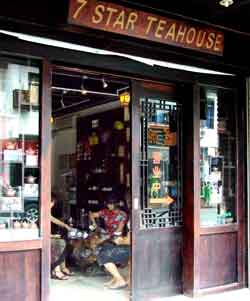
Seven Stars Green Tea in Guilin, home of South Chinas most picture-perfect scenery

While travelling with my friends in Guangxi province, southwest China, I was in the small backpacker-mecca of Yangshuo, nestled on the side of the Li River, in Guilin county, home to some of most well known scenery in all of Asia. Along the river, huge limestone karst peaks jut up into the air, giving the landscape a surreal beauty. The surrounding area is home to many of Chinas ethnic minorities, people who have a very distinct culture, lifestyle and language compared to the majority Han Chinese, who compose 90% of the population. Some of these minorities include the Zhuang people, Chinas largest minority and the Yao, famous for the womens really long hair. The town of Yangshuo, which is largely comprised of traditional white-washed houses, has become a backpackers paradise in recent years, with the main street, Xi Jie (west street) coming to refer more to the fact that is is full of westerners than that it is on the west of town. But several minutes of cycling will take you away from the western cafes, bars and hostels and into pristine countryside, where rice paddies and buffalos dominate, with the huge karsts jutting up randomly.


One evening I was walking along the street and I noticed a small teashop, called Seven Stars, so I decided to take a look and was invited by the owner, Annie Zhou, to sit down and try the local tea, Cuiyu, which is grown by her family in the nearby countryside. It had a distinct chestnutty taste with a clear green colour and the leaves were coated in small white furs. Her brothers plantation was opened in 2000, when he realised that as living standards were higher, people could afford to drink high quality tea. The plantation now covers 40 hectares of mountainside nearby Jiaobalin, a small village outside of town.

Sunday, 21 March 2010
Wu Dang Mountains, Mystical Retreat of Taoism, Ancestral Home of Tai Chi, A Centre of Tea

Many people who are familiar with China or martial arts will know that spread throughout the 72 peaks of Wu Dang are numerous Taoist temples, meditation retreats and Kung Fu schools. But what is lesser known is that this mountain range is home to some exceptional teas.
 For centuries Wu Dang has been shrouded in secrecy, the Taoist monks who live here have practiced Qigong, a kind of esoteric excercise combining soft movements, breathing techniques and meditation, for centuries. Around 1000 years ago an immortal named Zhang San Feng was said to find his way to this place, where he brought his Kung Fu. But after witnessing a fight between a snake and a crane he was inspired by the graceful and flowing movements of the animals and so was said to have created the "internal" branch of martial arts, which doesnt rely on brute power or strength, but on yielding to force and developing Qi, an intrinsic energy in the body.
  he martial arts developed and grew, and so did the monasteries on the mountains, with Wu Dang becoming a centre of many Taoist academic studies, not just martial arts but also medicine, fortune telling and agriculture. Of course with a refined understanding of the cycles of change in nature and the seasons, the monks were able to grow outstanding crops, one of which was tea, which survives to this day.
 At Wu Dang over 20 different kinds of tea are produced, all of which are organic and grown according to ancient taoist agricultural methods.They have many varieties of green tea, including Zhen Jing, Kung Fu and also wulong and black teas. I would love to see these teas become better known and spread, and hopefully in the future I will make them available to the west, so let me know if you are interested.
Subscribe to:
Posts (Atom)